Argentinian
Medialunas
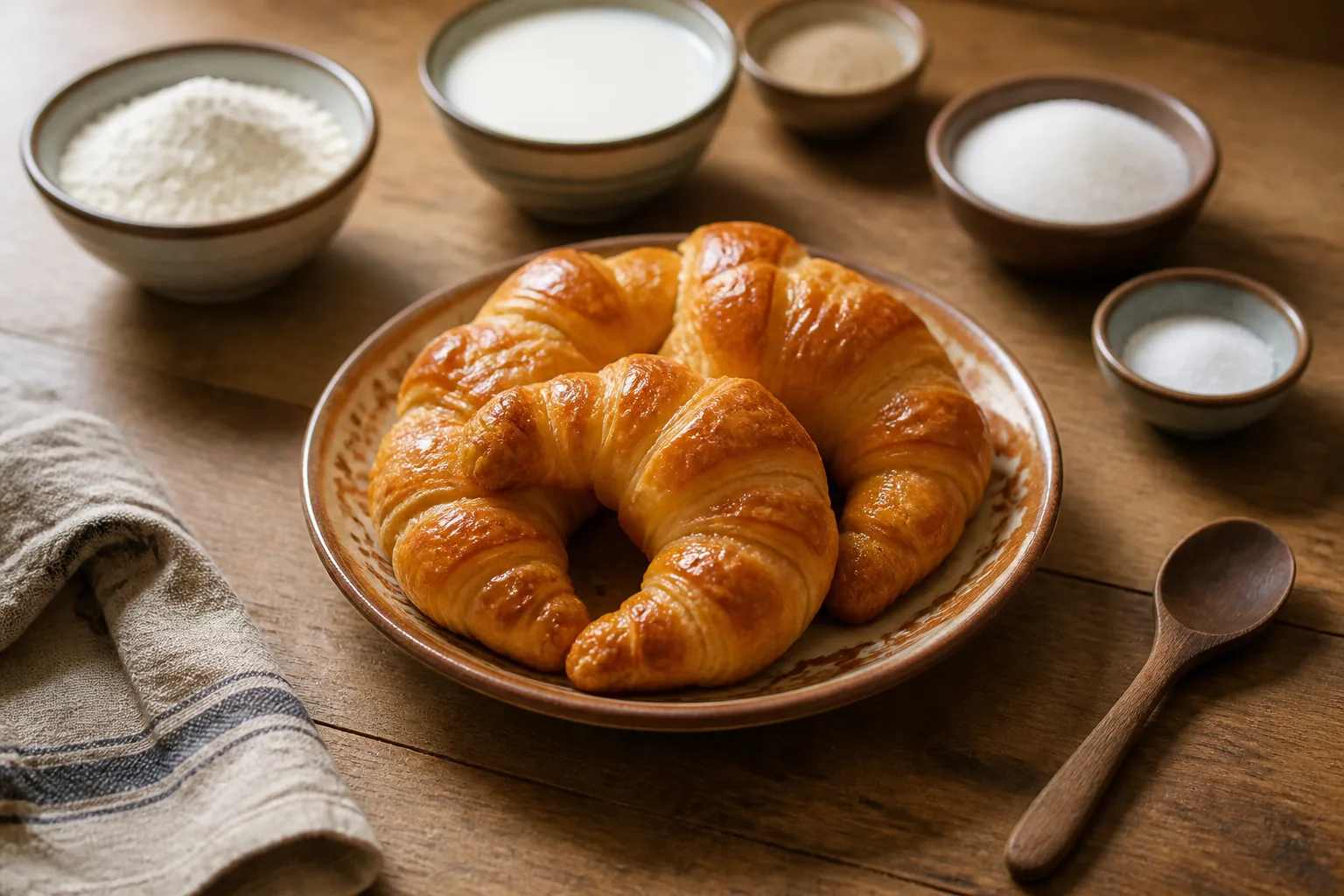
Tender Argentinian medialunas de manteca with a buttery laminated crumb and a shiny almíbar glaze. They are best served warm with café con leche, just as in a Buenos Aires café.
 Watch it madePaulina Cocina · 12:43
Ingredients
- Bread flour180g
- Instant yeast4g
- Whole milk, lukewarm70ml
- Granulated sugar30g
- Fine salt3g
- Egg, lightly beaten1/2 large
- Honey or barley malt syrup1 tsp
- Vanilla extract1/2 tsp
- Lemon zest1/4 tsp
- Unsalted butter, softened for the dough15g
- Unsalted butter, cold but pliable for laminating75g
- All-purpose flour, for dusting2 tbsp
- Egg yolk1
- Milk, for egg wash1 tbsp
- Granulated sugar, for almíbar40g
- Water, for almíbar40ml
Method
- Mix the bread flour, yeast, milk, sugar, salt, beaten egg, honey, vanilla, and lemon zest until a rough dough forms.
- Knead in the 15g softened butter and continue kneading for 8 to 10 minutes, until the dough is smooth and elastic.
- Shape the dough into a flat rectangle, wrap it, and chill for 45 minutes.
- Place the 75g laminating butter between sheets of baking paper and pound it into a neat 10 cm square, then chill until firm but still bendable.
- Roll the chilled dough into a 20 cm square, place the butter square in the center like a diamond, and fold the dough corners over it to seal completely.
- Roll the packet into a long rectangle about 1 cm thick, fold it in thirds like a letter, wrap it, and chill for 30 minutes.
- Repeat the rolling, letter fold, and 30-minute chill two more times, keeping the dough cold and lightly dusted with flour.
- Roll the laminated dough into a rectangle about 3 mm thick and trim the edges cleanly.
- Cut the dough into 6 long triangles, gently stretch each triangle, and roll from the wide end to the tip to form medialunas.
- Curve each roll into a crescent, tuck the tip underneath, and place them on a parchment-lined tray with space between them.
- Cover loosely and proof at warm room temperature for 1 to 1 1/2 hours, until puffy and almost doubled.
- Heat the oven to 200°C.
- Whisk the egg yolk with 1 tablespoon milk and brush the medialunas gently without pressing down.
- Bake for 12 to 15 minutes, until deeply golden and crisp at the edges.
- While they bake, simmer the 40g sugar and 40ml water for 2 minutes to make a light almíbar.
- Brush the hot medialunas generously with the warm almíbar and let them rest for 5 minutes before serving.
Common questions
Can I substitute the bread flour or the laminating butter in medialunas?
Yes. Bread flour gives the best structure, but all-purpose flour works if you want a slightly softer, less chewy crumb. For laminating, use high-fat unsalted butter; margarine or spreadable butter will leak and reduce the flaky layers.
How long does medialunas dough need to chill and rest during the process?
Plan on about 2 to 3 hours total with active chilling: 45 minutes after mixing, then 30 minutes after each of the three letter folds. Keep the dough cold but still rollable so the butter stays in layers.
What are the most common mistakes when making laminated medialunas?
The biggest mistakes are letting the butter get too soft, dusting with too much flour, and rolling too aggressively. That can tear the dough or smear the butter, which reduces lift and creates dense pastries instead of flaky layers.
How should I store medialunas, and can I freeze them?
Store cooled medialunas in an airtight container at room temperature for 1 to 2 days. For longer storage, freeze baked medialunas well wrapped for up to 2 months, then rewarm in a low oven to refresh the texture.
What is the best way to serve medialunas?
Serve them slightly warm or at room temperature, ideally the day they’re baked. They’re great plain, with coffee or hot chocolate, or split and filled with jam, dulce de leche, or ham and cheese for a savory version.