Armenian
Matnakash
Matnakash is a soft Armenian leavened bread with a glossy golden crust and the traditional finger-drawn grooves that give it its name. It is best served warm, torn by hand alongside cheese, herbs, soups, or khorovats.
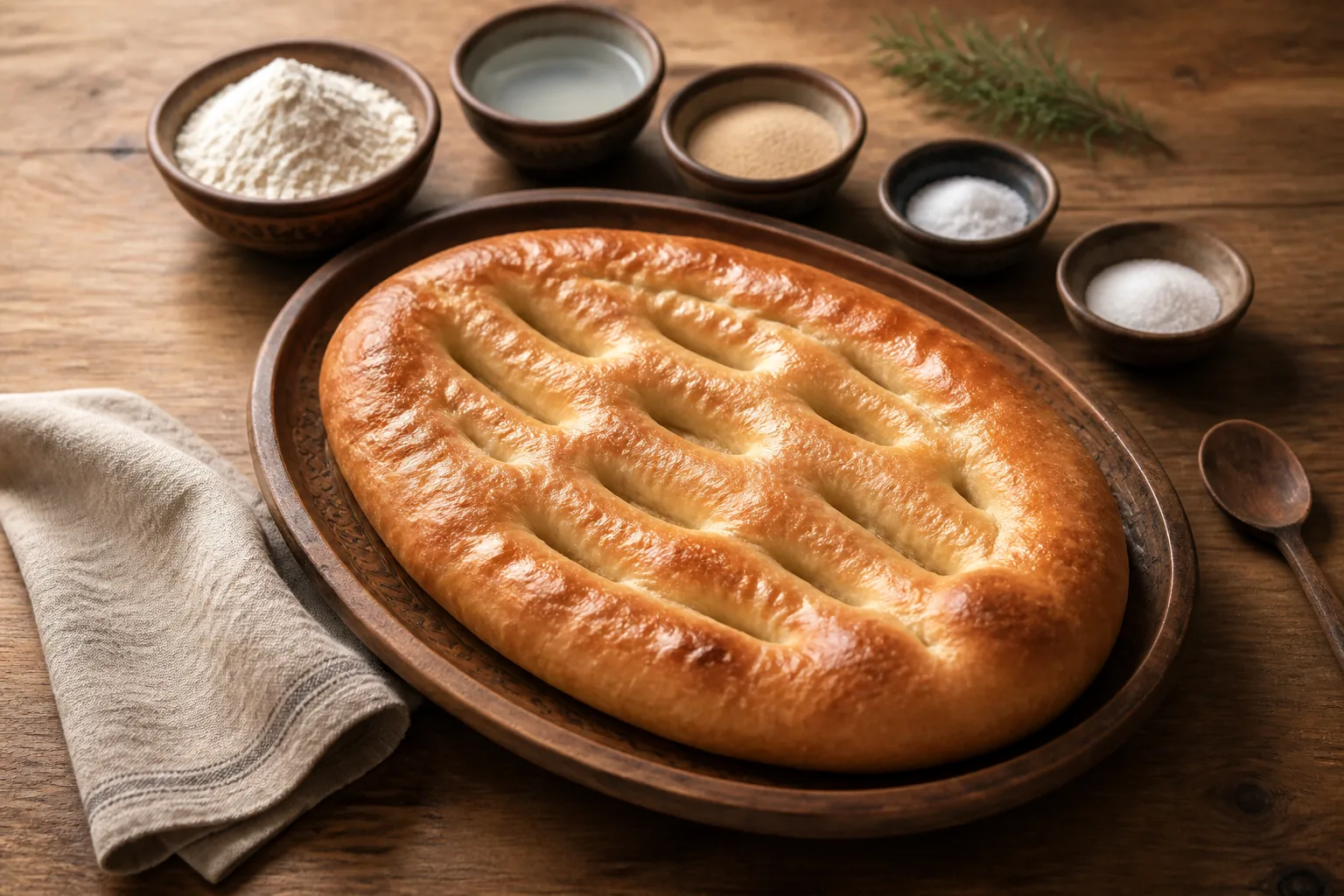
Ingredients
- Bread flour250g, plus 1 tsp for glaze
- Lukewarm water175ml, plus 2 tbsp for glaze
- Instant yeast3g
- Fine salt5g
- Sugar3g
- Neutral oil1 tsp, for the bowl and hands
Method
- Stir 250g bread flour, yeast, sugar, and salt together in a mixing bowl.
- Add 175ml lukewarm water and mix until a sticky, shaggy dough forms.
- Knead the dough in the bowl or on an unfloured surface for 8 to 10 minutes, wetting your hands as needed, until it becomes elastic and slightly smoother.
- Lightly oil a bowl, place the dough inside, cover, and let it rise in a warm place for 1 to 1 1/2 hours, until doubled.
- Punch down the dough gently, fold it over itself a few times, cover again, and rest for 20 minutes.
- Place a baking stone or heavy tray in the oven and preheat to 240°C for at least 30 minutes.
- Mix 1 tsp flour with 2 tbsp water in a small saucepan and cook over low heat for 1 to 2 minutes, stirring, until it forms a thin glossy paste; let it cool slightly.
- Transfer the dough to a parchment-lined peel or upside-down tray and gently stretch it into an oval about 22 cm long, keeping the center slightly puffy.
- Brush the surface with the cooled flour paste.
- Dip your fingers in water and press a deep oval groove around the edge, then press 2 or 3 long parallel grooves down the center without cutting through the dough.
- Rest the shaped loaf uncovered for 10 minutes so the grooves relax but remain visible.
- Slide the loaf onto the hot stone or tray, splash a little water into a separate hot pan for steam, and bake for 15 to 18 minutes until deeply golden and hollow-sounding underneath.
- Cool the matnakash on a rack for at least 10 minutes before tearing and serving warm.
Common questions
Can I substitute all-purpose flour for bread flour in matnakash?
Yes, but the loaf will be a little less chewy and may spread more. If using all-purpose flour, hold back 10–15 ml water at first and add only if the dough feels too dry and stiff.
How long does the dough need to rise, and how do I know it is ready?
Plan on 1 to 1 1/2 hours for the first rise, depending on room temperature. It is ready when doubled in size and looks puffy; if you poke it gently, the dent should spring back slowly.
What are the most common mistakes when making matnakash?
The biggest issues are adding too much flour, under-kneading, and not preheating the oven long enough. The dough should stay sticky, the crumb will improve with proper kneading, and a very hot stone or tray helps the crust set quickly.
How should I store matnakash after baking?
Cool it completely, then store at room temperature in a paper bag or loosely wrapped in a clean towel for 1 day. For longer storage, freeze it well wrapped; reheat from frozen in a hot oven until warmed through.
What is the best way to serve matnakash?
Serve it warm or room temperature with cheese, herbs, yogurt, soups, or grilled meats. It is also great split and filled with savory spreads. For the best texture, reheat briefly in the oven before serving.