Swedish
Lussekatter
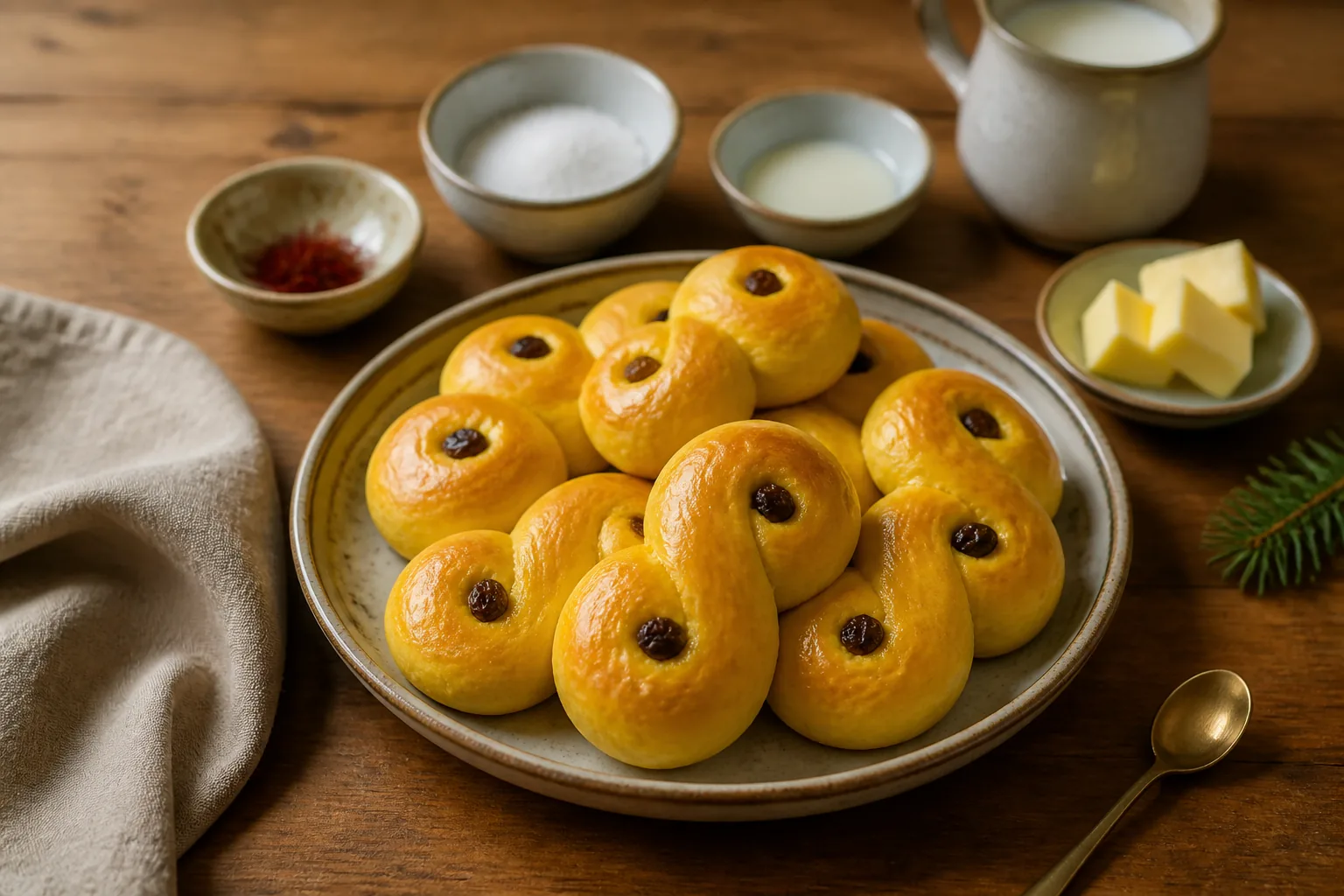
Golden Swedish saffron buns shaped into curled S forms and dotted with raisins, traditionally baked for Lucia in December. The dough is enriched with milk, butter, and saffron for a soft crumb and warm floral aroma.
 Watch it madeAndreas kök · 11:21
Ingredients
- Saffron threads0.25g
- Granulated sugar, for grinding saffron1/2 tsp
- Vodka or warm milk, for blooming saffron1 tsp
- Whole milk100ml
- Unsalted butter35g
- Fresh yeast12g
- Granulated sugar30g
- Fine salt1/4 tsp
- All-purpose flour180g, plus more as needed
- Raisins24 raisins
- Egg, beaten, for brushing1/2 egg
Method
- Crush the saffron with 1/2 tsp sugar in a mortar, stir in the vodka or warm milk, and let it bloom for at least 10 minutes.
- Soak the raisins in warm water while you make the dough so they do not dry out in the oven.
- Warm the milk gently to about 37°C, then stir in the butter until mostly melted.
- Crumble the fresh yeast into a mixing bowl and pour over the warm milk mixture, stirring until dissolved.
- Add the bloomed saffron, sugar, salt, and most of the flour, then knead for 8 to 10 minutes until the dough is smooth, elastic, and slightly tacky.
- Cover the bowl and let the dough rise in a warm place for about 45 minutes, or until nearly doubled.
- Drain the raisins and pat them dry.
- Turn the dough onto a lightly floured surface, divide it into 4 equal pieces, and roll each piece into a rope about 25 cm long.
- Shape each rope into an S by curling both ends in opposite directions, then place the buns on a parchment-lined baking sheet.
- Press one or two raisins into each curl of every bun.
- Cover loosely and let the lussekatter proof for 30 to 40 minutes, until puffy.
- Heat the oven to 225°C.
- Brush the buns lightly with beaten egg.
- Bake for 7 to 9 minutes, until deep golden yellow and just cooked through.
- Cool on a wire rack under a clean towel so the buns stay soft.
Common questions
Can I substitute active dry yeast or instant yeast for fresh yeast in Lussekatter?
Yes. Use about one-third the weight if substituting instant yeast, or about half the weight for active dry yeast. If using active dry yeast, dissolve it in the warm milk first and let it sit 5 to 10 minutes.
How long does Lussekatter dough need to rise, and how do I know it is ready?
The first rise usually takes about 45 minutes in a warm spot, but go by size, not the clock. It is ready when the dough is nearly doubled and feels airy but still slightly resilient when pressed.
What are the most common mistakes when making Lussekatter?
The biggest mistakes are overheating the milk, which can kill the yeast, and adding too much flour, which makes the buns dry. Also, shape them gently so they stay soft and avoid baking too long.
How should I store Lussekatter, and can I freeze them?
Store cooled buns in an airtight container at room temperature for 1 to 2 days. For longer storage, freeze them well wrapped for up to 2 months. Thaw at room temperature and warm briefly before serving.
What is the best way to serve Lussekatter?
Serve them slightly warm with coffee, tea, or glögg. They are best fresh from the oven or lightly reheated. Brush with egg before baking for a glossy finish, and add raisins before proofing so they bake in securely.