Persian
Kuku Sabzi
Kuku sabzi is a fragrant Persian herb frittata, dense with parsley, cilantro, dill, chives, and a touch of fenugreek. It is traditionally cooked slowly until the edges are crisp and the center is tender, often with walnuts and barberries for texture and brightness.
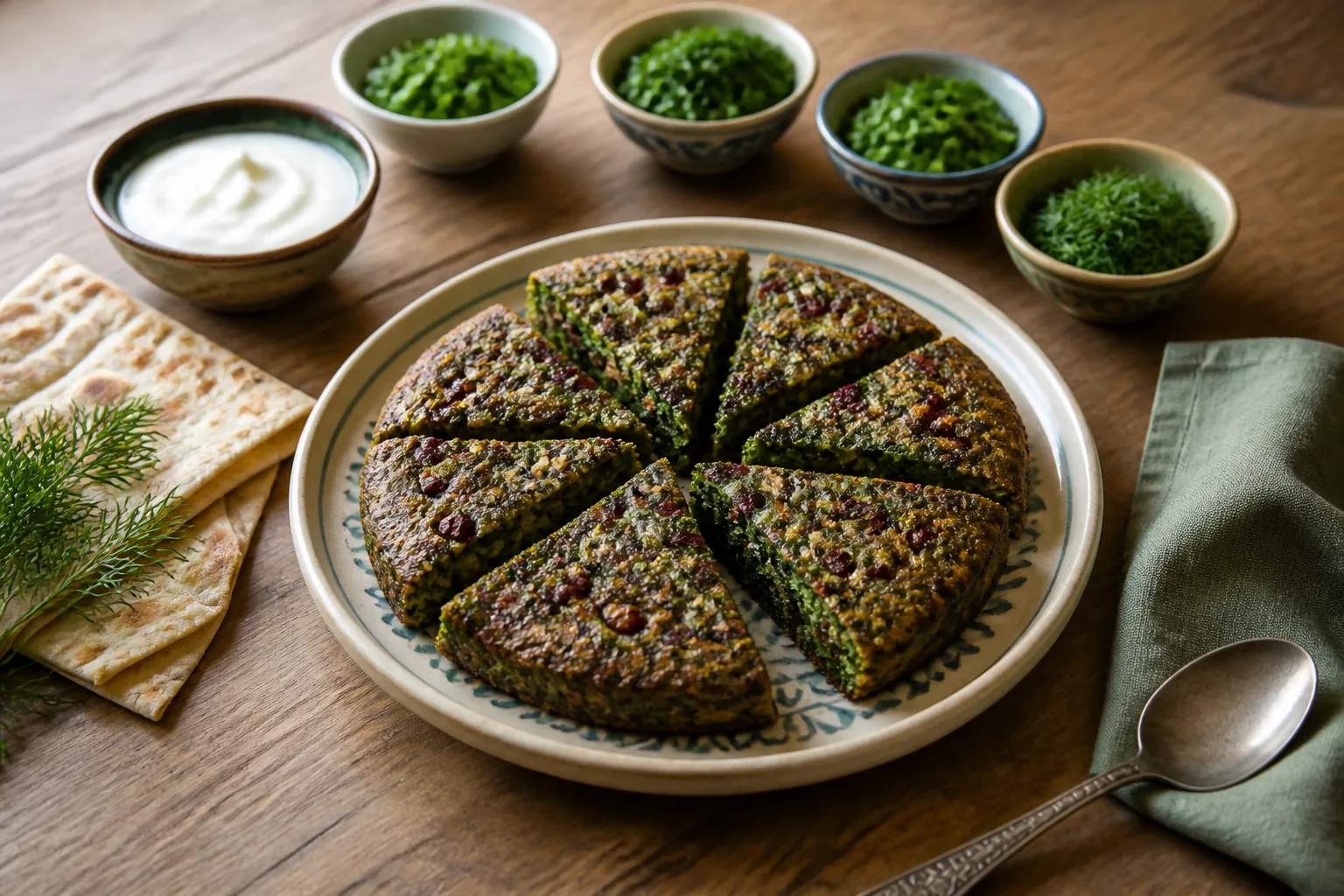
Ingredients
- Large eggs3
- Fresh parsley, finely chopped1 cup
- Fresh cilantro, finely chopped3/4 cup
- Fresh dill, finely chopped1/2 cup
- Fresh chives or green parts of scallions, finely chopped1/2 cup
- Dried fenugreek leaves1 teaspoon
- Walnuts, roughly chopped2 tablespoons
- Dried barberries1 tablespoon
- All-purpose flour1 teaspoon
- Ground turmeric1/2 teaspoon
- Fine salt3/4 teaspoon
- Black pepper1/4 teaspoon
- Vegetable oil3 tablespoons
Method
- Wash the herbs well, dry them thoroughly, and chop them very finely so the kuku holds together without becoming watery.
- Place the barberries in a small bowl, rinse briefly, and drain well.
- In a mixing bowl, beat the eggs with the turmeric, salt, black pepper, and flour until smooth.
- Stir in the parsley, cilantro, dill, chives, dried fenugreek, walnuts, and drained barberries until the herbs are evenly coated with egg.
- Heat the vegetable oil in a small nonstick or well-seasoned skillet over medium heat until shimmering.
- Pour in the herb mixture, spread it evenly, and cook for 2 minutes until the edges begin to set.
- Reduce the heat to low, cover the skillet, and cook for 12 to 15 minutes until the bottom is browned and the top is mostly set.
- Cut the kuku into quarters in the pan, carefully turn each piece over, and cook uncovered for 5 to 7 minutes until the second side is browned and the center is cooked through.
- Transfer to a plate and let rest for 5 minutes before serving warm or at room temperature.
Common questions
Can I substitute the herbs in Kuku Sabzi if I can't find all of them fresh?
Yes. Keep parsley and dill as the backbone, then use more cilantro, chives, or scallion greens to replace missing herbs. If fenugreek is unavailable, use a little extra dill or skip it, but the flavor will be slightly less classic.
How do I know when Kuku Sabzi is fully cooked and ready to flip?
The edges should look set, the bottom should be deeply golden, and the top should be mostly firm with only a slight wobble in the center. If the top is still very wet, give it a few more minutes covered on low heat.
What are the most common mistakes when making Kuku Sabzi?
The biggest mistakes are wet herbs, chopping too coarsely, and cooking on heat that is too high. Wet herbs make the kuku loose and soggy, large pieces prevent it from holding together, and high heat burns the bottom before the center sets.
How should I store leftover Kuku Sabzi, and can I reheat it?
Cool it completely, then store in an airtight container in the refrigerator for up to 4 days. Reheat slices in a skillet over low heat or in a 325°F/165°C oven until warmed through; microwaving works but softens the texture.
What should I serve with Kuku Sabzi?
Serve it warm or at room temperature with flatbread, Persian rice, yogurt, torshi, or fresh herbs and greens. It also works well with a simple salad and tea, and the barberries add enough brightness that it does not need a heavy sauce.