Sudanese
Kawari
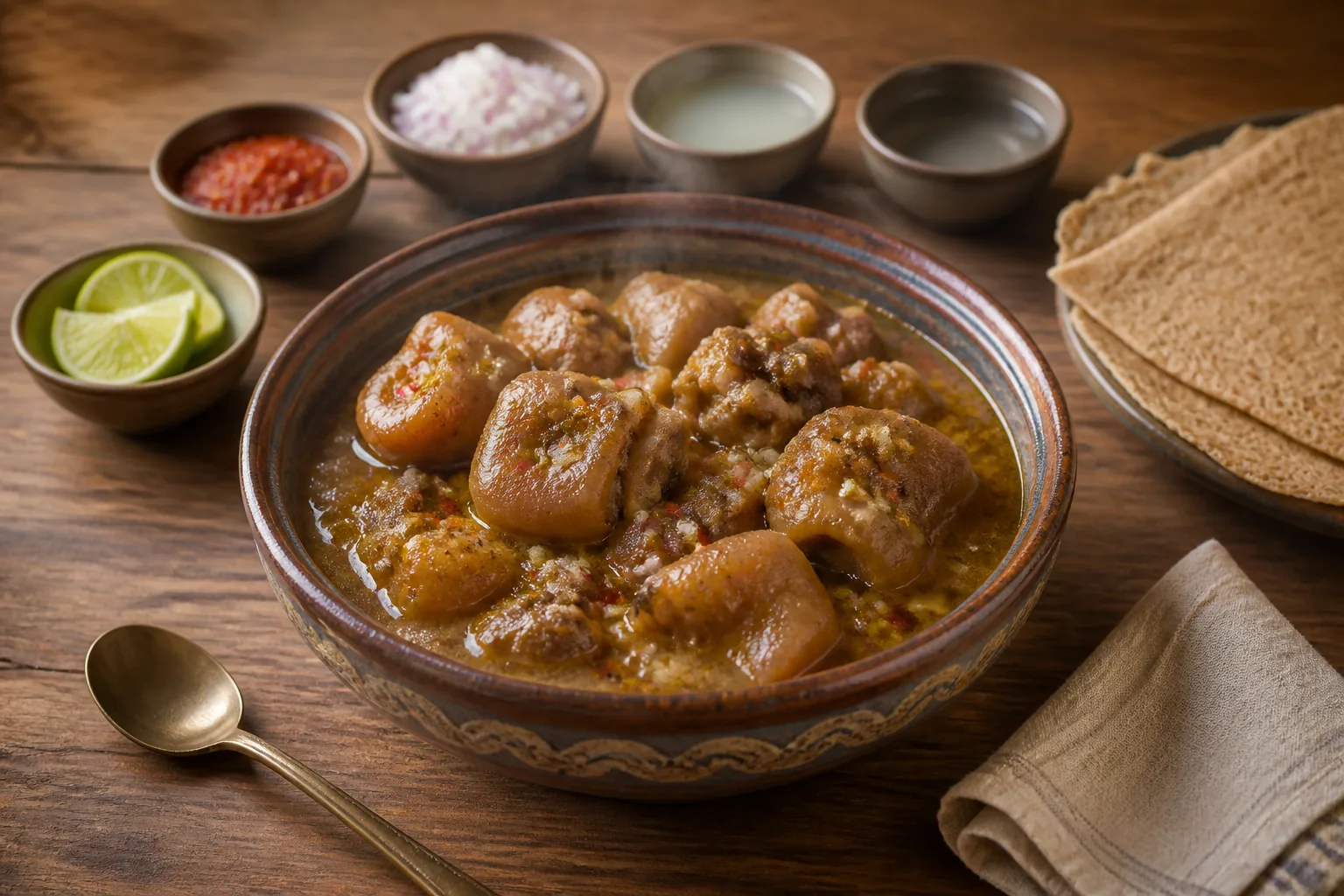
Kawari is a Sudanese cow-trotter stew with a deep, silky broth and soft gelatinous meat. It is traditionally simmered slowly with onions, garlic, warm spices, and finished with lime and chilli, then eaten with kisra or bread.
 Watch it madeThe Golden Balance · 1:01
Ingredients
- Cleaned cow trotters, split into pieces1.2 kg
- White vinegar or lime juice3 tbsp
- Water8 cups
- Onion, finely chopped1 large
- Garlic cloves, crushed5
- Fresh ginger, grated1 tsp
- Tomato paste1 tbsp
- Ground cumin1 tsp
- Ground coriander1 tsp
- Black pepper1/2 tsp
- Ground cardamom1/4 tsp
- Cinnamon stick1 small
- Bay leaf1
- Salt1 1/2 tsp, or to taste
- Green chilli, slit1
- Lime1, cut into wedges
- Sudanese shatta or crushed red chillito serve
- Kisra or flatbreadto serve
Method
- Rinse the split trotters very well, scraping away any dark bits, then rub them with vinegar or lime juice and rinse again.
- Place the trotters in a pot, cover with fresh water, bring to a boil for 10 minutes, then drain and rinse the trotters and pot to remove scum.
- Return the trotters to the clean pot with 8 cups water, the chopped onion, garlic, ginger, cinnamon stick, bay leaf, cumin, coriander, black pepper, cardamom, and salt.
- Bring to a strong boil, skim the surface, then reduce to a gentle simmer and cover the pot slightly ajar.
- Simmer for 3 to 3 1/2 hours, stirring occasionally, until the skin and connective tissue are very soft and the broth feels rich and sticky.
- Stir in the tomato paste and slit green chilli, then simmer uncovered for 25 to 30 minutes until the broth is well flavoured and slightly thickened.
- Taste and adjust the salt, then remove the cinnamon stick and bay leaf.
- Serve the kawari hot in deep bowls with plenty of broth, lime wedges, shatta, and kisra or flatbread for dipping.
Common questions
Can I substitute cow trotters with another cut if I can’t find them?
Yes, but the texture will change. Beef shanks, oxtail, or a mix of beef bones and a little gelatin-rich meat can work. They won’t give the same sticky trotters texture, so expect a lighter broth and less collagen.
How long does Kawari take to cook until the trotters are fully tender?
Plan on about 3 to 3 1/2 hours of gentle simmering after the initial parboil and rinsing. The trotters are ready when the skin and connective tissue are very soft and the broth has turned rich and slightly sticky.
What are the most common mistakes when making Kawari?
The biggest mistakes are not cleaning the trotters well, skipping the parboil and rinse, boiling too hard during simmering, and adding too much water later. A strong boil can make the broth cloudy and toughen the texture.
How should I store leftover Kawari, and does it freeze well?
Cool it quickly, then refrigerate in a covered container for up to 3 to 4 days. It freezes well for about 2 to 3 months. The broth may gel in the fridge because of collagen, which is normal.
What is the best way to serve Kawari?
Serve it hot with bread, rice, or sorghum porridge, and spoon plenty of broth over the top. A simple salad, pickled chilies, or fresh lime on the side helps balance the rich, gelatinous stew.