Egyptian
Kahk
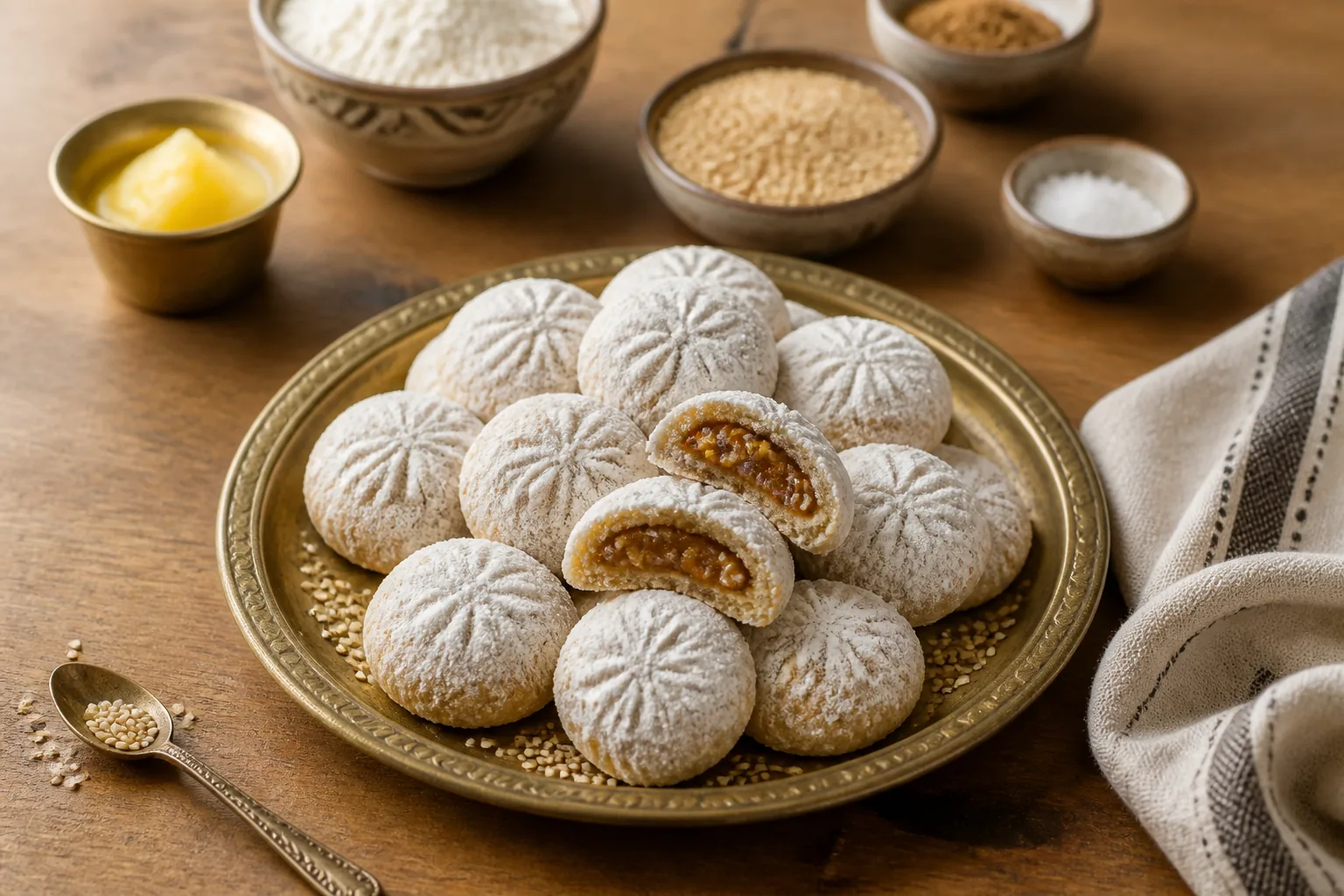
Egyptian kahk are tender Eid butter cookies scented with kahk essence and sesame, filled here with honey agameya and buried in powdered sugar. They should be pale, crumbly, and rich from hot ghee worked into the flour.
 Watch it madeAya Habib - آية حبيب · 11:12
Ingredients
- All-purpose flour1 cup
- Ghee1/3 cup, plus 1 tbsp for filling
- Toasted sesame seeds1 tbsp for dough, plus 1 tbsp for filling
- Kahk essence or ground kahk spice1/4 tsp
- Fine salt1 pinch
- Instant yeast1/4 tsp
- Sugar1/4 tsp
- Warm milk2 to 3 tbsp
- Honey2 tbsp
- Flour for agameya filling1 tbsp
- Ground cinnamon1 small pinch
- Powdered sugar1/3 cup
Method
- Make the agameya filling by melting 1 tbsp ghee in a small pan, stirring in 1 tbsp flour, and cooking over low heat until lightly golden and nutty.
- Stir in the honey, 1 tbsp toasted sesame seeds, and cinnamon, then cook for 1 to 2 minutes until thick and glossy.
- Transfer the agameya to a small plate and let it cool until firm enough to pinch into 6 tiny balls.
- Mix the yeast, sugar, and 2 tbsp warm milk in a small bowl and leave for 5 minutes until slightly foamy.
- In a heatproof bowl, combine the flour, 1 tbsp toasted sesame seeds, kahk essence, and salt.
- Heat 1/3 cup ghee until fully melted and hot but not smoking, then pour it over the flour mixture.
- Stir carefully with a spoon, then when cool enough to handle, rub the ghee into the flour with your fingertips for 3 to 4 minutes until the mixture feels sandy and evenly coated.
- Add the yeast mixture and knead very lightly just until a soft dough forms, adding the remaining 1 tbsp warm milk only if the dough is dry.
- Cover the dough and rest it for 25 to 30 minutes.
- Divide the dough into 6 pieces, flatten each piece, place one agameya ball in the center, and seal the dough around it completely.
- Shape each filled piece into a smooth round cookie and press the top with a kahk mold, maamoul mold, or fork to mark a pattern.
- Arrange the cookies on a parchment-lined tray and bake at 180°C for 15 to 18 minutes, until set and barely golden on the bottom while the tops remain pale.
- Let the kahk cool completely on the tray so they do not crumble.
- Dust generously with powdered sugar just before serving.
Common questions
Can I substitute ghee or kahk essence if I don’t have them?
Use unsalted butter for ghee, but the dough will be less rich and less traditional. If you can’t find kahk essence, use a small pinch of ground anise, fennel, and mahlab if available, or simply leave it out.
How long does the dough need to rest before baking?
This dough usually needs only a short rest, about 20 to 30 minutes, just enough to relax before shaping. Don’t let it rise much; kahk should stay tender and crumbly, not airy like bread.
What are the most common mistakes when making kahk?
The biggest mistakes are overheating the ghee, overworking the dough, and adding too much milk. The dough should feel sandy and barely come together. If it gets sticky or elastic, the kahk may bake tough.
How should I store kahk after baking?
Cool completely, then store in an airtight container at room temperature for up to 1 week. For longer storage, freeze baked kahk for up to 2 months. Dust with powdered sugar only after thawing so it stays neat.
How should kahk be served?
Serve kahk fully cooled, generously dusted with powdered sugar just before serving. It’s commonly enjoyed with tea or coffee. If using agameya filling, let the cookies rest a few hours so the filling sets and the flavor settles.