Sudanese
Gurasa
Gurasa is a soft Sudanese wheat flatbread cooked slowly on a hot griddle until thick, tender, and lightly blistered. It is traditionally served warm with mullah or a rich stew spooned over the top.
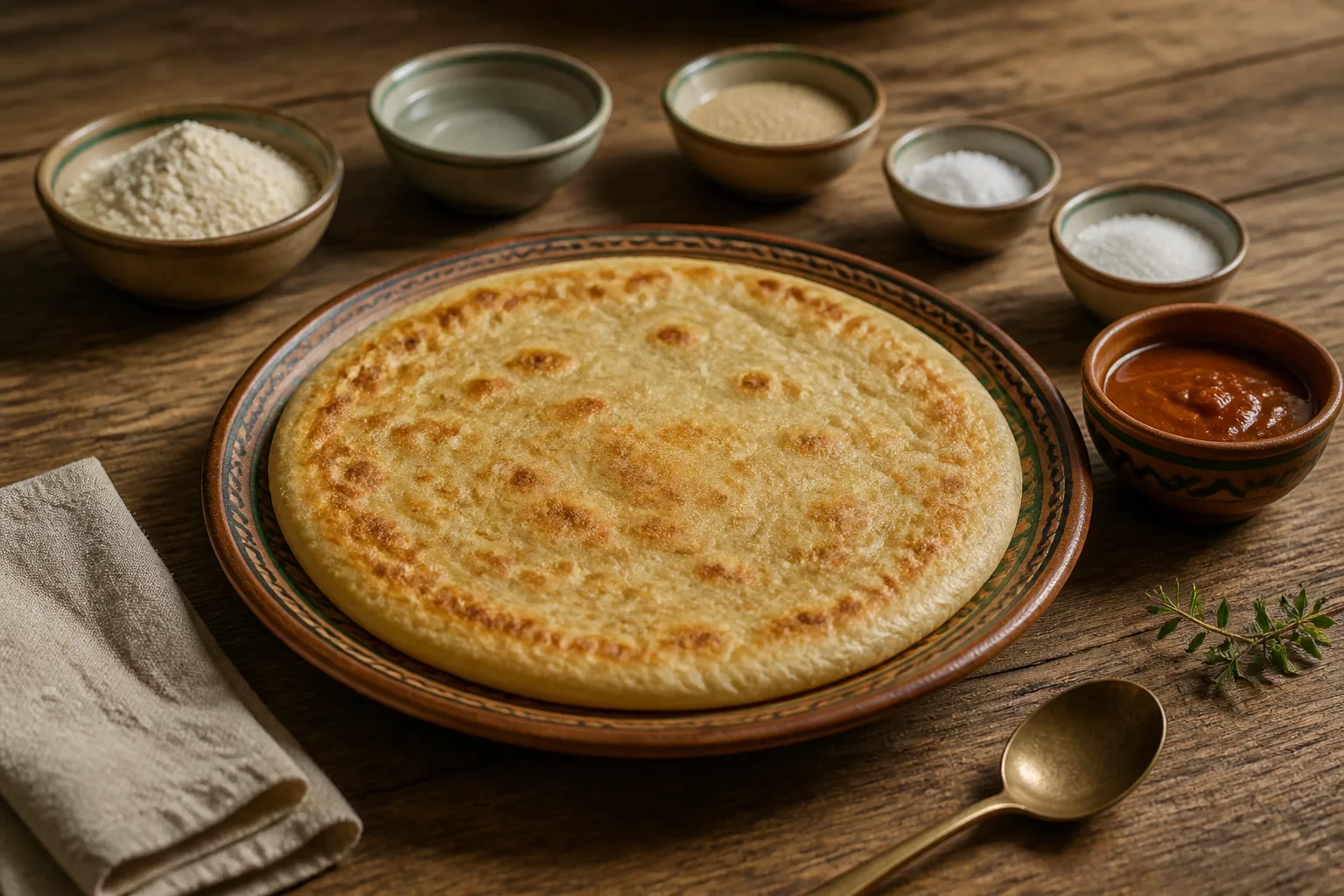
Ingredients
- All-purpose wheat flour1 1/2 cups
- Warm water1 cup plus 2 tbsp
- Instant yeast1/2 tsp
- Sugar1/2 tsp
- Salt1/2 tsp
- Neutral oil1 tbsp, for the griddle
Method
- Mix the yeast, sugar, and warm water in a bowl and let it stand for 5 minutes until slightly foamy.
- Add the flour and salt, then beat firmly by hand for 3 to 4 minutes until the batter is smooth, stretchy, and thicker than crepe batter.
- Cover the bowl and let the batter ferment in a warm place for about 1 hour, until bubbly and lightly risen.
- Heat a flat griddle, tawa, or heavy skillet over medium heat and wipe it lightly with oil.
- Stir the batter once, then pour half of it onto the griddle and spread it quickly into a thick round about 20 cm wide using the back of a ladle or your wet fingertips.
- Cook for 4 to 5 minutes until the top looks set, the edges dry slightly, and the underside is golden with a few brown spots.
- Flip the gurasa and cook the second side for 2 to 3 minutes, keeping it soft rather than crisp.
- Transfer to a plate, cover with a clean towel, and repeat with the remaining batter.
- Serve warm, whole or torn into pieces, with Sudanese mullah, meat stew, okra stew, or lentils spooned over it.
Common questions
Can I substitute bread flour or whole wheat flour for all-purpose flour in gurasa?
Yes. Bread flour gives a slightly chewier, more elastic gurasa, while whole wheat flour makes it denser and nuttier. For best texture, replace only 25–50% of the flour at first, and add a little extra water if the batter thickens too much.
How long should I let the batter ferment, and how do I know it is ready?
Usually about 1 hour in a warm place. It is ready when the batter looks bubbly, slightly risen, and smells mildly yeasty. If your kitchen is cool, it may take longer; if it overferments, the flavor can become sharp and the texture less tender.
What are the most common mistakes when cooking gurasa?
The biggest mistakes are making the batter too thick, cooking on heat that is too high, and flipping too early. The batter should pour and spread easily, and the first side should be set enough before turning so the bread stays soft and does not tear.
How should I store leftover gurasa, and can I reheat it?
Cool completely, then wrap tightly or place in an airtight container. Keep at room temperature for 1 day or refrigerate for up to 3 days. Reheat on a dry skillet over low heat or wrap in foil and warm briefly in the oven.
What are the best ways to serve gurasa?
Serve it warm and soft with stews, soups, beans, or saucy dishes, where it can be torn and used for scooping. It also works with butter, honey, or jam for breakfast, and it is best eaten soon after cooking for the softest texture.