Vietnamese
Chả giò
Crisp Vietnamese fried rice paper rolls filled with pork, shrimp, taro, wood ear mushrooms, and glass noodles. Serve them hot with lettuce, fresh herbs, and nước chấm for wrapping and dipping.
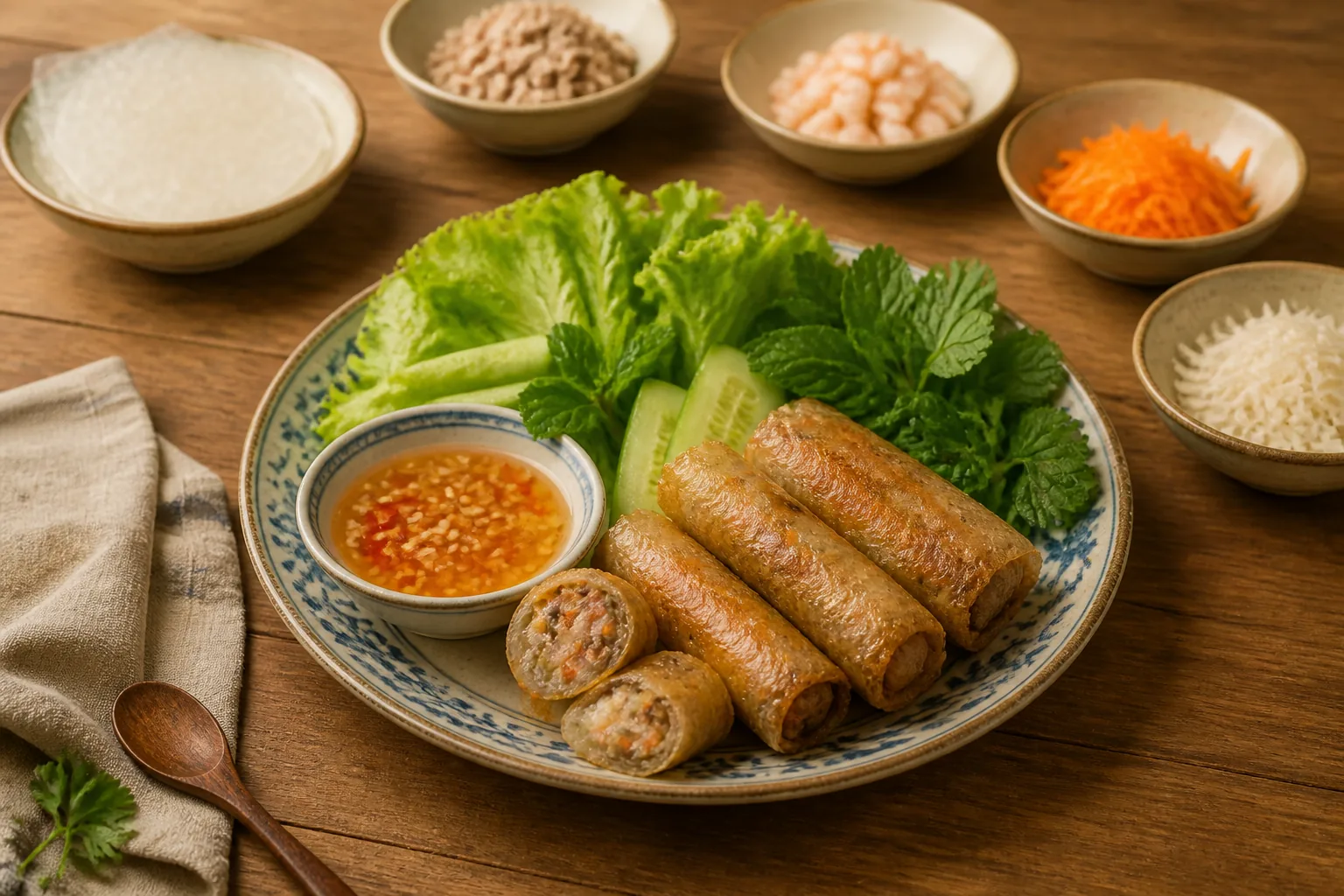
Ingredients
- Small dried rice paper wrappers8 sheets
- Ground pork120g
- Raw shrimp, peeled and finely chopped80g
- Taro, peeled and finely grated1/2 cup
- Carrot, finely shredded1/4 cup
- Dried wood ear mushrooms2 pieces
- Dried mung bean glass noodles20g
- Shallot, minced1 small
- Garlic, minced1 clove
- Egg yolk1
- Fish sauce1 tsp
- Sugar1/2 tsp
- Ground white pepper1/4 tsp
- Neutral oil, for deep-frying3 cups
- Green leaf lettuce6 leaves
- Fresh mint, cilantro, and Vietnamese coriander1 cup
- Cucumber, cut into batons1/2 small
- Warm water, for nước chấm3 tbsp
- Fish sauce, for nước chấm1 1/2 tbsp
- Lime juice, for nước chấm1 1/2 tbsp
- Sugar, for nước chấm1 tbsp
- Garlic, finely minced, for nước chấm1 small clove
- Bird's eye chili, thinly sliced, for nước chấm1
Method
- Soak the wood ear mushrooms in warm water for 15 minutes, then trim, squeeze dry, and finely chop.
- Soak the glass noodles in warm water for 10 minutes, drain well, and cut into 2 cm lengths.
- Make the nước chấm by stirring warm water and sugar until dissolved, then add fish sauce, lime juice, minced garlic, and sliced chili.
- In a bowl, combine pork, shrimp, taro, carrot, wood ear mushrooms, glass noodles, shallot, garlic, egg yolk, fish sauce, sugar, and white pepper.
- Mix the filling in one direction until sticky and evenly combined, then chill for 10 minutes.
- Set up a clean board and a shallow bowl of water; quickly swipe one rice paper wrapper with water so it softens slightly but is not limp.
- Place about 2 tablespoons of filling near the lower third of the wrapper, shape it into a compact log, fold in the sides, and roll firmly without trapping air.
- Repeat with the remaining wrappers and filling, placing the rolls seam-side down while you work.
- Heat the oil in a wok or deep saucepan to 160°C.
- Fry the rolls in batches for 6 to 7 minutes, turning often, until pale golden and cooked through; remove to a rack.
- Increase the oil temperature to 180°C and fry the rolls a second time for 1 to 2 minutes until deeply golden, blistered, and crisp.
- Drain on a rack for a few minutes, then serve hot with lettuce, herbs, cucumber, and nước chấm.
Common questions
Can I substitute the taro or glass noodles if I can’t find them?
Yes. For taro, use finely grated potato or jicama for a similar light starchiness, but squeeze out excess moisture. For glass noodles, use very finely chopped cellophane noodles or omit them; the filling will be a little less bouncy.
How long does the filling need to chill before rolling, and why?
Chill the mixed filling about 10 to 15 minutes. It firms up, making the rolls easier to shape and less likely to burst. Don’t skip it if the mixture feels wet or loose.
What are the most common mistakes when rolling chả giò?
Over-wetting the rice paper, overfilling, and leaving air pockets are the biggest problems. The wrapper should be just softened, the filling compact, and the roll tight enough to seal but not stretched thin.
Can I make chả giò ahead of time or freeze them?
Yes. Assemble uncooked rolls, separate them with parchment, and refrigerate up to 24 hours. For longer storage, freeze on a tray until firm, then bag them. Fry from frozen or slightly thawed for best texture.
What’s the best way to serve chả giò, and what sauce goes with it?
Serve hot and crisp with nước chấm, lettuce, herbs like mint and cilantro, and sometimes rice vermicelli. Let guests wrap the rolls in lettuce or dip directly for a fresher, less greasy bite.