Korean
Bossam
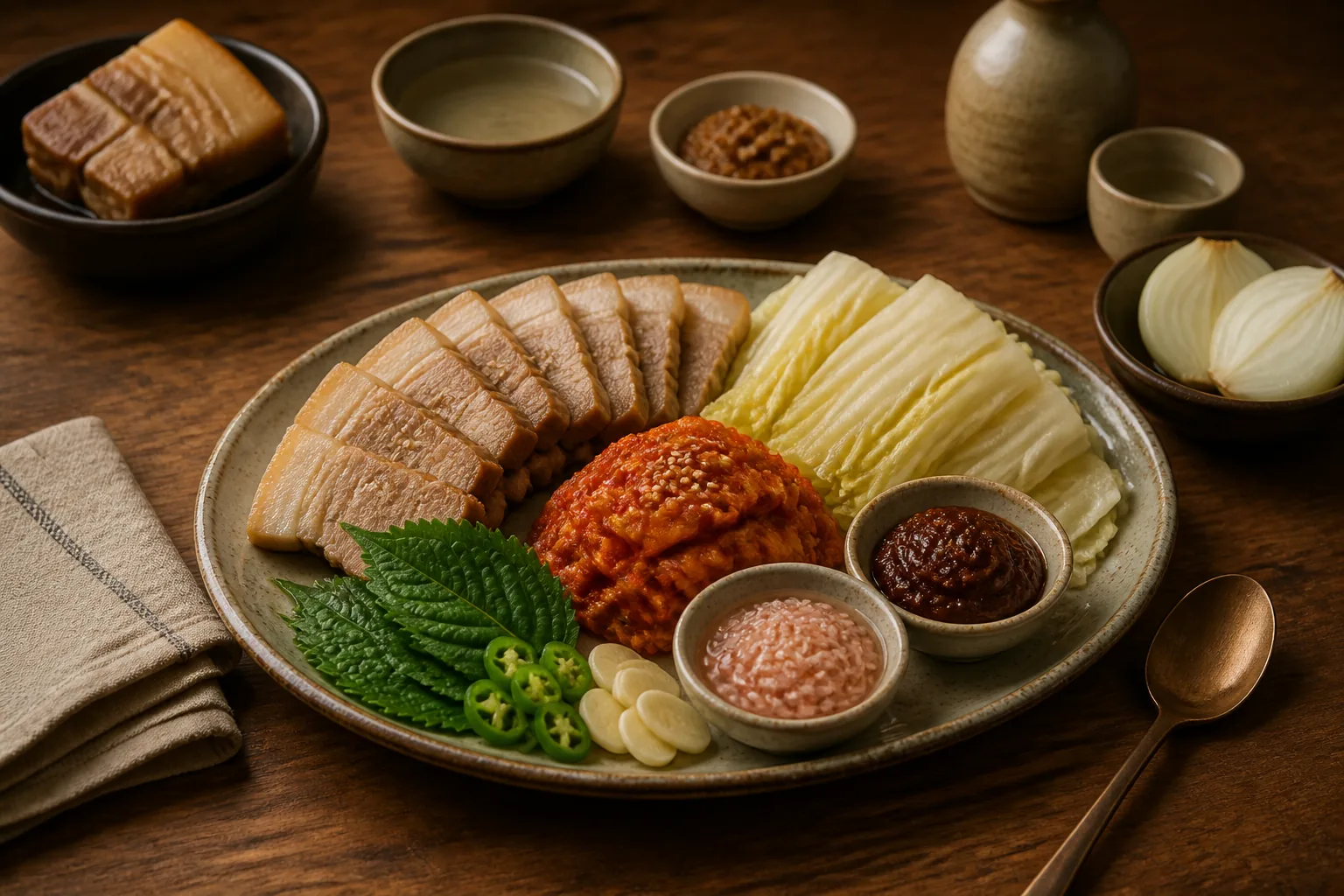
Tender slices of doenjang-simmered pork belly are wrapped in lightly salted napa cabbage with kimchi, ssamjang, garlic, and salted shrimp sauce. It is a comforting Korean table dish meant to be assembled bite by bite while the pork is still warm.
Ingredients
- Pork belly slab, skin-on if available600g
- Water1.5 liters
- Doenjang3 tbsp, divided
- Soju or cheongju1/4 cup
- Yellow onion, halved1/2
- Garlic cloves, smashed8 cloves, divided
- Fresh ginger, sliced4 thin slices
- Large scallion or daepa1, cut into large pieces
- Bay leaf1
- Black peppercorns1 tsp
- Napa cabbage leaves8 large leaves
- Coarse sea salt2 tbsp
- Ripe kimchi or bossam kimchi1 cup
- Saeujeot, salted fermented shrimp2 tbsp
- Gochugaru1 tsp
- Gochujang1 tsp
- Toasted sesame oil2 tsp
- Toasted sesame seeds1 tsp
- Honey or rice syrup1 tsp
- Fresh Korean green chili, sliced1
- Perilla leaves6 leaves
Method
- Sprinkle the napa cabbage leaves evenly with coarse sea salt, especially the thick white stems, and let them soften for 30 minutes.
- Rinse the salted cabbage leaves briefly, squeeze out excess water gently, and set them aside for wrapping.
- In a heavy pot, combine the water, 2 tablespoons doenjang, soju, onion, 6 smashed garlic cloves, ginger, scallion, bay leaf, and black peppercorns, then bring to a boil.
- Add the pork belly slab to the boiling broth, reduce to a steady simmer, cover partly, and cook for 50 to 60 minutes until a skewer slides into the meat with little resistance.
- Turn off the heat and let the pork rest in the hot broth for 10 minutes so it stays juicy.
- Meanwhile, make ssamjang by mixing 1 tablespoon doenjang, gochujang, 1 teaspoon sesame oil, honey or rice syrup, 1 minced garlic clove, and half of the sesame seeds.
- Make the saeujeot sauce by roughly chopping the salted shrimp and mixing it with gochugaru, 1 minced garlic clove, 1 teaspoon sesame oil, sliced green chili, and the remaining sesame seeds.
- Lift the pork from the broth, pat the surface lightly, and slice it across the grain into 1/4-inch thick pieces.
- Arrange the warm pork slices on a platter with the salted napa leaves, perilla leaves, kimchi, ssamjang, and saeujeot sauce.
- To eat, place pork in a cabbage or perilla leaf, add kimchi, ssamjang, and a little saeujeot, then wrap into one compact bite.
Common questions
Can I substitute pork belly with another cut for bossam?
Yes, but pork belly gives the classic rich, tender result. Pork shoulder or butt works if you want a leaner, more affordable option. Cook a little longer until very tender, and keep the broth gently simmering so it stays juicy.
How long do I need to salt the napa cabbage leaves?
About 30 minutes is enough for most napa leaves. Salt the thick white stems more heavily than the leafy parts, then rinse briefly and squeeze gently. If the leaves are very thick, give them up to 45 minutes.
What are the most common mistakes when making bossam?
The biggest mistakes are boiling the pork too hard, under-salting the cabbage, and skipping the rest in hot broth. A hard boil makes the meat tough; a gentle simmer and a 10-minute rest keep it tender and moist.
How do I store leftover bossam and cabbage?
Store the pork, cabbage, sauces, and kimchi separately in airtight containers. Refrigerate for up to 3 days. Reheat the pork gently with a splash of broth or water; don’t microwave it too long or it can dry out.
What should I serve with bossam for the best meal?
Serve warm sliced pork with salted cabbage leaves, bossam kimchi or ripe kimchi, saeujeot sauce, and ssamjang. Add cooked rice, garlic slices, chili, or raw onion if you like. Wrap everything just before eating for the best texture.